FINAL-e: Maruti Suzuki e-Vitara First Drive
The e-Vitara isn't an 'out-of-the-box' product, but it checks all the right boxes. We drove the made-in-India-for-the-world car in the UK to find out what to expect next month, at the time of its India launch.

eVOLUTION
How many of you remember the 2018 Expo and the e-Survivor being showcased there? A concept so futuristic that everyone was certain it would not be seen in the market anytime soon. It was the FUTURO-e at the 2020 Expo that gave some hint of direction and a vision that Maruti Suzuki is serious about a compact SUV-ish electric car. The real proof of intent came much later with the EVX. The direction that led us to this, the eVitara, showcased at the Bharat Mobility Expo first, and then rolled out for the global market from the Gujarat plant earlier this year, now stood in front of us in Buckinghamshire, England, around 90 kms (or, as they measure it there, 55 miles) away from London. This is the EV everyone was waiting for and the first electric car from the market leader. Why was this product crucial?
See, we can't properly gauge the potential or future of electric cars in India unless the market leader, with more than 9000 touchpoints and over 40% of the market share, introduces its electric car. Look at what Maruti's exit did to the diesel car market. After all, this is the brand that gave us the "kitna-deti-hai" mantra. How practical or economical EVs are, whether the charging network is really an issue, and if Indian customers are really ready to embrace the lithium-ion revolution, or is it just a passing trend? The real picture of EVs in India needed this, and that is why we went to the UK to drive a made-in-India global product from Maruti Suzuki.
DeSIGN
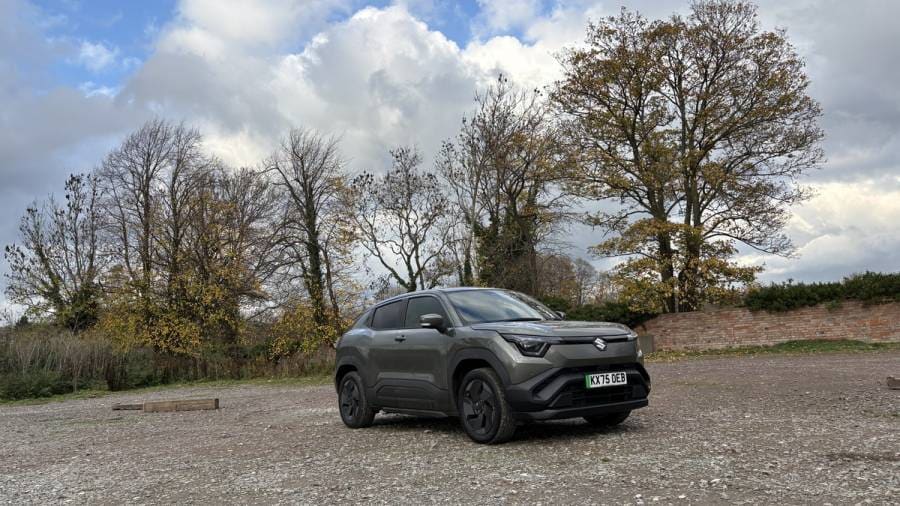
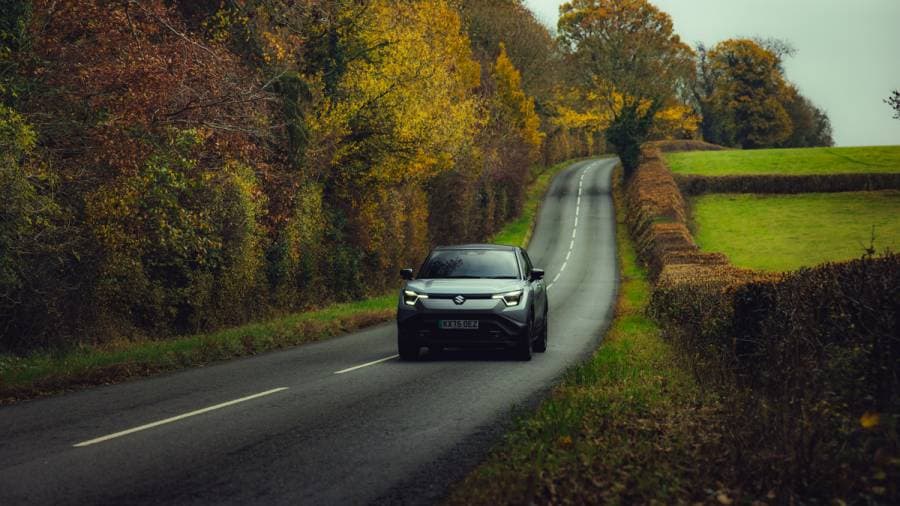
One look at this car and you get a typical Suzuki vibe with modern interpretations, like the sharp-looking Y-shaped LEDs, a chiselled body, thanks to various creases and prominent lines running along the hood and shoulders. The wheel arches are angular, with black extensions, and a black cladding covers the sides, extending over the door sills. The door handles at the front are body coloured and the rear set is tucked inside the C-pillar. Overall design feels muscular and compact, not too much in your face. The Suzuki logo, placed on the nose with a black closed grille underneath, is the only prominent element that reminds you of an electric vehicle; the aero-shaped alloys are perhaps the other. The signature LED at the front, the fog lamps at the bottom of the front grille, and a glass finish in the middle of the connected tail lamp panel give a very sharp and modern feel. You also get a rear upper spoiler. In the UK, the eVITARA is available in 11 different colour combinations: six single-tone colours, including white, black, blue, grey, and silver, and five dual-tone options, with red being an exclusive dual-tone option. Overall, this is a look that is not polarising and will be acceptable for a wide variety of buyers.
DIMeNSION
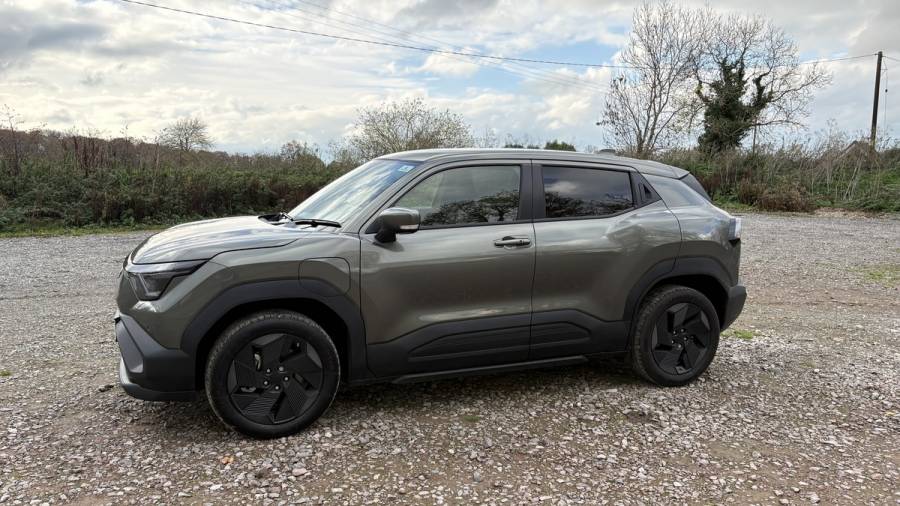
The eVITARA is a true-blue member of the 4.3-metre family, a length that has created a separate, dominant family in the Indian car market. The overall length of this car is 4,275 mm, the width is 1,800 mm, and the height is 1,635 mm. The wheelbase is 2,700 mm, and the ground clearance is 185 mm. The eVITARA comes with 225/55 R18 tyres in the base and mid variants, while the dual motor version features R19 tyres.
BATTeRY
There are two battery options available in the eVITARA: 49 kWh and 61 kWh. The smaller battery pack produces 144 PS of power and 193 Nm of torque. The variant we drove was called 'MOTION' and was fitted with a 61-kWh battery with a power output of 174 PS and 193 Nm of peak torque. This was a two-wheel drive option, while there is a top variant called Ultra with a 61-kWh battery, which comes in two-wheel or All Wheel Drive options with a dual motor, in Suzuki's language, ALLGRIP. Overall, the claimed WLTP combined range is 264 miles, which translates to approximately 425 km. If you recall the presentations from the Bharat Mobility Expo, the claimed range for the Indian market is likely to be around 500 km. The on-road price is £32,999, which is equivalent to ?38.5 lakh. However, this conversion may differ for the Indian version, as we expect the Indian pricing to be approximately half of that, ranging from ?16 to ?24 Lakh.
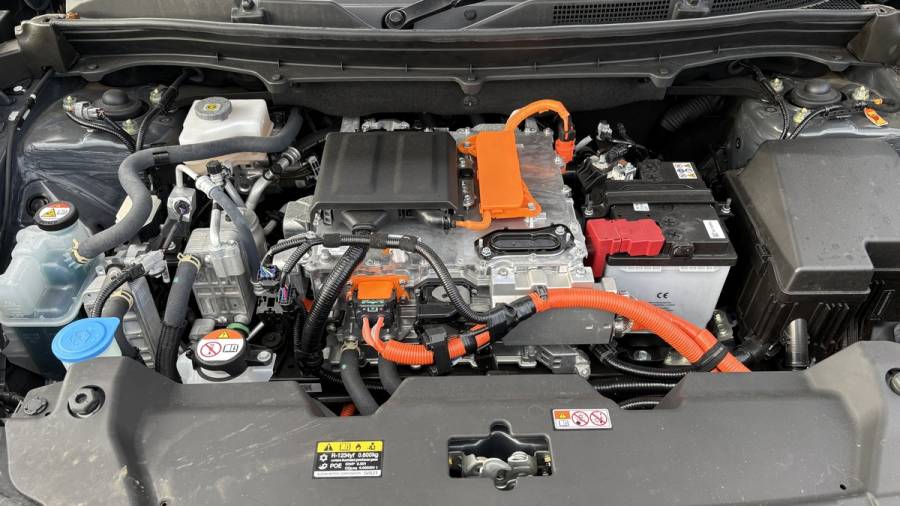
The dual motor version produces a combined power of 184 PS with the help of a 48-kW rear motor and 307 Nm of peak torque. The 0-100 kmph figures differ on all three versions, but the top speed is 150 kmph for all of them. The small battery version reaches 100 in 9.6 seconds, the bigger battery with a single motor in 8.7 seconds, and the dual motor version does 0-100 kmph in 7.4 seconds.
CHARGe
Now let's talk about the charging setup. Using a 7 kW AC fast charger with the 61-kWh option, charging from 10% to 100% will take approximately 9 hours. The same charging will take 5 hours and 30 minutes if you use an 11 kW 3-phase AC fast charger. DC fast charging will reduce the charging time for 10-80% charging to 45 minutes. The 49-kWh battery option will take between 4:30 and 6:30 hours from AC fast chargers and 45 minutes for DC fast charging.
eCONOMY
The 49 kWh comes with a consumption figure of 9.5 km/kWh in cities and 6.7 km/kWh for combined driving. The overall range is between 344 and 482 km. The single motor, 61 kWh version offers a city consumption of 9 km/kWh and 6.6 km/kWh in combined driving conditions. The range varies between 426 and 581 km, depending on whether the vehicle is used on city streets or highways. However, the range is lower in the dual motor version, which is between 395 and 526 km. The consumption is between 6 and 8 km/kWh.
INTeRIORS
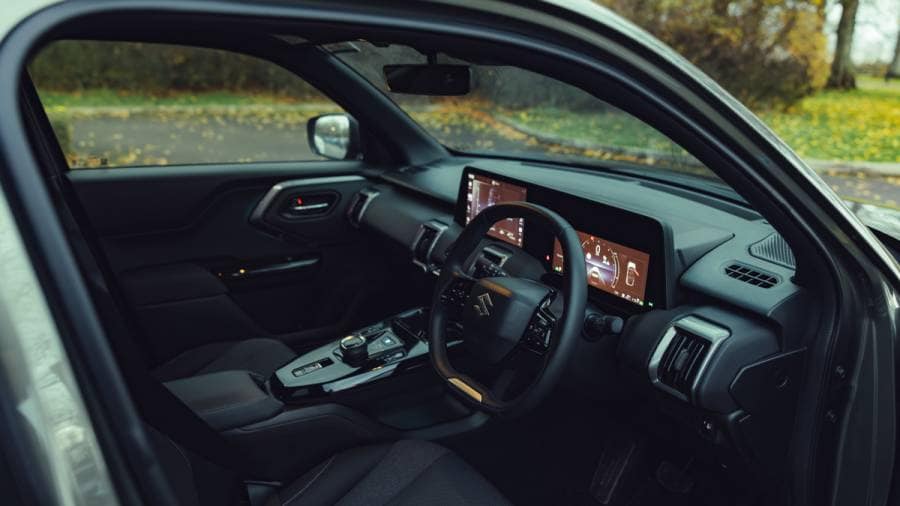
A two-spoke steering wheel, with audio, menu, and some ADAS feature controls, welcomes you in the cabin. As seen at the Gujarat Plant roll-out event, this one features dark tan, soft-touch trims on the dash.
The seats, upholstery, and fit and finish are a significant improvement in the eVITARA. There are plastic bits and panels, but most of them appear well-put together and polished. One highlight for me was the rotary drive selector, featuring a nice, dull metallic look with a rubbery lining, making it gentle to hold and easy to use. Simply push it down and rotate left or right to select drive or reverse mode. In Gen-Z language, it has an aesthetic vibe.
The eVITARA comes with a 10.25-inch infotainment screen and a 10.1-inch MID. It features an in-built navigation system and comes with wireless smartphone connectivity, supporting Android Auto and Apple CarPlay. You also get a very versatile and practical 360 camera, which gives a detailed impression of your whereabouts, sides, front, rear and even some areas just under the body. The resolution of those cameras didn't appear to be HD, which seems to be an area of improvement.
There is a 12-volt accessory socket and a couple of USB ports located under the floating-style centre console. It's nice to look at, but it requires a bit of extra work to locate those ports. The Motion variant we drove had manual seat adjustment and heated driver and front passenger seats, features we obviously won't find in the Indian version. The top end also gets 10-step adjustable powered seats. The second row features a 40:20:40 split, along with sliding and reclining functions. Smart and practical. And not to forget, customers in the UK get three-year subscriptions for Suzuki Connect Connected Services. That means features like remote air conditioning, seat heating, and steering wheel heating via Suzuki Connect would be possible. The UK model didn't have dedicated rear AC vents, but it did have two USB ports and a slot to keep one phone.
SPACe
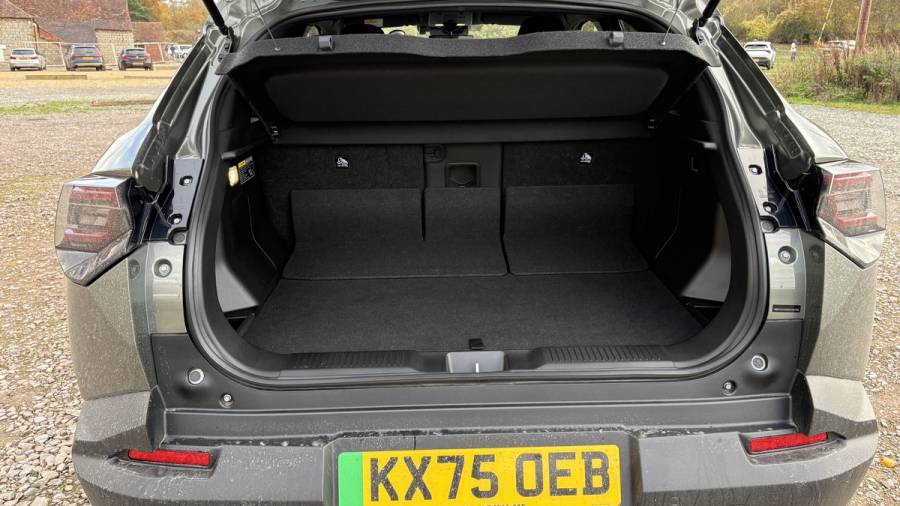
Stepping into the e-Vitara's second row reveals a familiar and predictable passenger experience. The entry was easy, where the senior members of your family won't face any challenge. The seats are well-cushioned and feel spacious enough for two passengers, and can be considered adequate for three. For a person of around 190 cm in height, the knee room, leg space, and headroom were satisfactory, making them more than adequate for average-sized Indian customers. However, as this is an EV and the floor incorporates the batteries, you sit with your knees a bit higher, which means thigh support is what you usually see in such vehicles. An issue most electric cars face to this date. The 40:20:40 split makes the second row and the luggage space more flexible. With the rear seat adjusted to its most forward position, the luggage space measures approximately 310 litres, decreasing to 244 litres when the second-row seats are fully back. However, if you fold the second-row seats, you get 562 litres of luggage space.
DRIVe
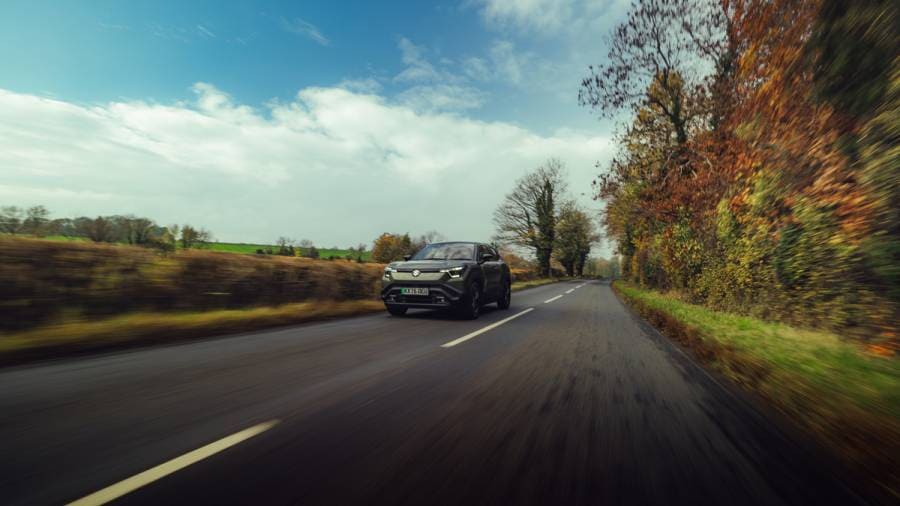
During the short drive we went for, from Buckinghamshire to Warwickshire, the roads were quite undulating. Not choppy but wavy. While narrow roads are typical of the setup, the uneven surface gave us a good idea about the expected comfort level of the eVITARA in Indian conditions. The ride felt composed and comfortable, leaning on a bit of a rigid side of things, but this is something which can work on typical driving surfaces in our metros. I couldn't use the ADAS functions but managed to toggle between different driving modes, namely Eco, Normal, and Sport. It also gets different traction settings under the 'Snow' mode. There is a separate regenerative braking button on the centre console to switch on or off, unlike the norm these days. But, there are no regen-pedals on the steering wheel. The stretch we drove on had speed limits between 30 and 60 MPH. In those conditions, the drive performance of the eVITARA felt engaging and quick. The power figures are somewhere between 'OK' and 'WOW'. This car pulls without any drama and feels capable enough to do triple-digit cruising. Other than the tyre and road noise, the whole experience can be called relaxed and easy. Just like the design bit, the drive performance will satisfy a wide variety of drivers. Drivers looking for more than Eco and Normal modes will enjoy the Sport mode; the small tug on the steering while rapid acceleration is enough to give you confidence while overtaking and to provide driving pleasure.

SAFeTY
In addition to the ADAS Level 2 functions, this list includes ABS with EBD, electronic stability program, hill hold control, driver and front airbags, a front passenger airbag deactivation system, and side, curtain, and driver's knee airbags. The eVitara comes with ISOFIX child seat anchorages and a tyre pressure monitoring system. You also get a blind spot monitor, rear cross-traffic alert, lane keep assist, lane departure prevention, traffic sign recognition, and e-call.
VeRDICT
The burden of expectation, when a regular launch plan starts to feel like a delay or a wait too long. This is what I realised, while asking Maruti Suzuki India's bosses, why did they wait for so long? The reality was that we, the media, and the industry watchers expected the car earlier, not Maruti so much. Right from the beginning, their EV timeline was always 2025. Even when we caught the electric version of WagonR running around on Delhi-NCR roads, or when other manufacturers went all out on the EV front. We all knew that Japanese car makers are more into hybrids than electric vehicles, and they got on the electric bandwagon a bit late. Now the final product was in front of us with a promise of an Indian launch in the first week of December. The time taken by Maruti Suzuki has saved them from various turbulences and confusion in the electric market, as well as the anxiety of other manufacturers. It has also provided them with valuable lessons on the EV ecosystem and customer behaviour in India. But it also means a semi-developed segment and many competitors thriving. Which leads to an obvious question- what will be the USP of this car? And I hope it's the same one the number one carmaker of India is known for and capable of delivering: overall value.
Related Stories