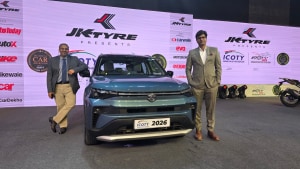
Kia Syros vs Mahindra 3XO vs Skoda Kylaq comparison review - the new guys
You can't be selling cars in India and not have a sub-4m SUV in your lineup. There are about 14 such SUVs on sale now, of which these three are the newest. The Skoda Kylaq and Mahindra 3XO might be for someone who is looking for a bit of performance and driver engagement thrown in the mix. But if smart and sensible is at the top of your list of priorities, the Kia could be your thing. But which of these is best?
Kia Syros vs Mahindra 3XO vs Skoda Kylaq Styling, Dimensions
While all of these cars are under 3,995mm long, it's the Kia Syros that seems to take up the most space on the road. Its polarizing shape has something to do with this, as it's the tallest car here at 1,680mm. The boxy, slab-sided look is intended to be practical but the details mean you will have an opinion on it. We think it could have been toned down a bit but the blank frontal look and vertical headlamps give it a distinct signature. Yes, the placement of these lamps may make them vulnerable in traffic, but in the rains they also seem to catch grime easily.
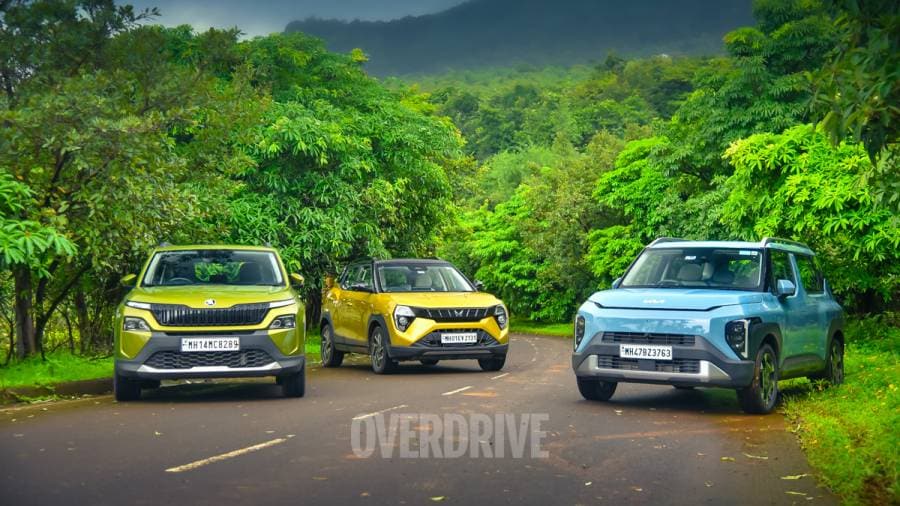
The glass area with the asymmetrical B-pillar is reminiscent of the Skoda Yeti and is the least divisive element about the car. In fact, the tall roof, tapered C-pillar elements and square haunches give it the most character from this angle, even though at 1,680mm it's the tallest car here. The rear is again quite a break from the norm with its flat bootlid and small lighting.
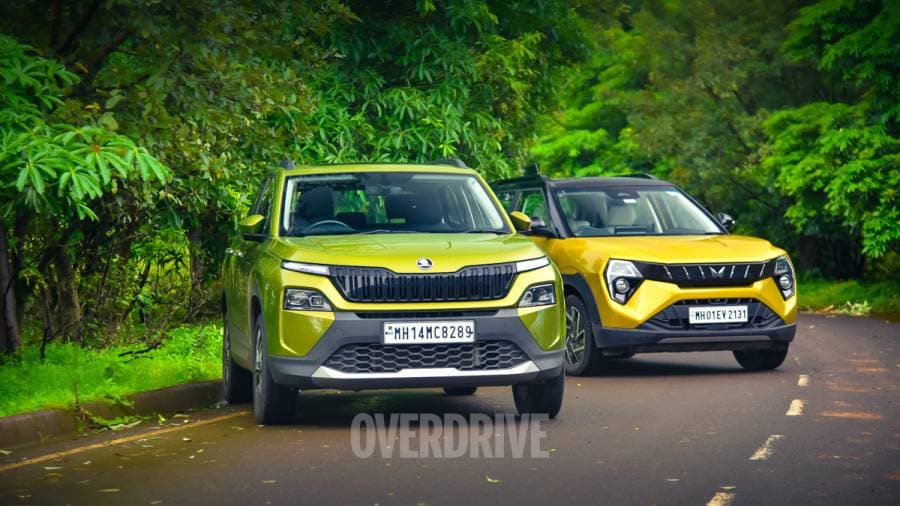
The Skoda Kylaq sits on the other end of the spectrum, being the shortest and narrowest car here. It looks the most compact but is possibly one of the more proportionate sub-4m cars we have seen in a while. The new Skoda design philosophy adds a bit more flair, but the Kylaq will still age gracefully like other Skoda cars. The compact light design and wide grille give it good presence despite the size. All the cars here get 17-inch wheels but they seem to work best with the size of the Kylaq.
The rear is as cohesive as the front. The sculpted boot adds to the proportions, as do the compact lamps. A smart touch that adds a dose of aggression is the plastic panel with the Skoda branding.

As before, the Mahindra 3XO is your best bet if you want to make a strong initial impression. The big gloss black panels with the chrome slats and tiered lighting give it that big SUV charm the most convincingly of the three cars here. The long flat bonnet, chunky cladding and upright glass panels add to the presence, helped by this being the widest car here at 1,821mm.

The abrupt rear has been improved quite a bit, the full-width lighting gives the Mahindra the most distinct look here. It fits with the design well and is better executed than the Syros but the effect is not quite as cohesive as the Kylaq.
Kia Syros vs Mahindra 3XO vs Skoda Kylaq Boot Space
The Kia has a 465-litre boot, but the Skoda's 446-litre space is more usable. The Syros may have a lower lip but it has a wider opening. The load is deeper than in the Syros because of the angled seatback of the Kia.

At 346 litres, the Mahindra is some way behind the other two, so you have a high lip and while the space is without too many intrusions, it still has quite a high floor. If you are carrying a full family's worth of luggage, you will have to pack tightly in the Mahindra.
Kia Syros vs Mahindra 3XO vs Skoda Kylaq interiors, space, practicality
We always come away quite impressed by the way Kia packages its MPV-themed cars and the Syros carries on this trait. Stepping inside, the first thing you notice is just how large it feels given its small footprint. The high roof, large windows and low sill contribute to this. This also makes the Syros one of the easier cars here to thread through traffic.

You get an expansive view out, something the 3XO also does well, but the larger windows in the Kia make things a touch easier. The Kylaq has generally good visibility but can't match the others in this test. There is a slightly high dash and lower seating, which the enthusiast will like very much.

With a Skoda, you expect it to ace build and cabin ambience, which the Kylaq does to a good extent. In many ways, this is a more premium space than the larger Kushaq, with the creative textures and colours that Skoda has used in the cabin. You notice this with the ridges and rough texturing on the dash and the green plastics used in the doors.
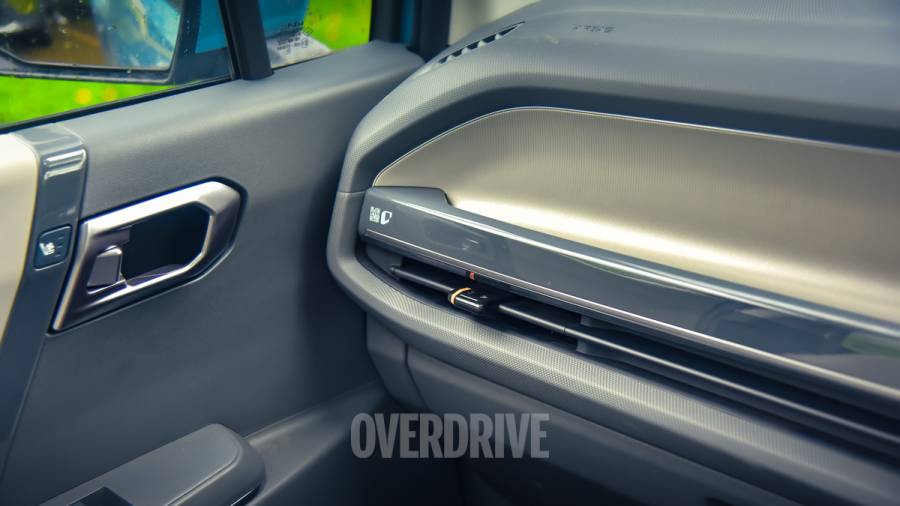
It's close between this and the Kia. The Syros seems influenced by larger models like the EV9 with its floating dash design and similar controls and screen arrangements. Like the Skoda, there is not much in the way of soft surfaces aside from the armrests, but you have the same great texturing and fit. The light grey and beige colour palate works in the Kia's favour to enhance its sense of openness.
A differentiator that puts the Kia ahead is when you spend more time in the cabin and realize that the Syros is the easiest car to interact with. It has physical controls for most functions, like the 3XO, but there is a damped, premium sense to all the buttons that the other two cars are lacking. This is especially apparent in the steering controls. The touch panel in the Kylaq feels quite difficult to use in this context.

The 3XO's biggest asset is its big car feel. Even with the Syros at hand, you get the sense that the 3XO could be from a segment higher. Its wide cabin and big seats make you feel luxurious in a way. There is also way more soft surfaces here, on the dash and doors. The stitching is a nice touch and works with the light contrast cabin.
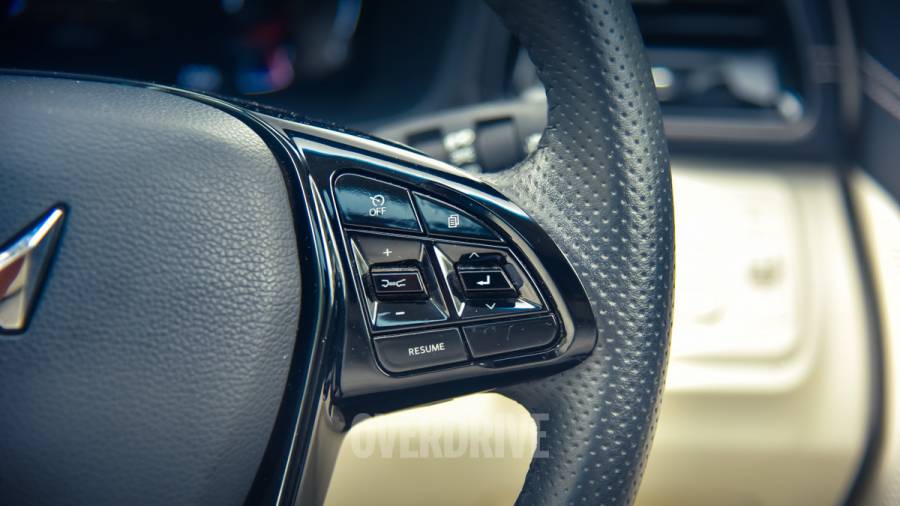
But this does not quite have the modernity or plush look of the other two cars. The plastics and textures don't feel as well-executed as in the other two, although the car seems consistently put together. The gloss black panels are prone to scratches and the switches, though chunky, have a flimsy feel to them.
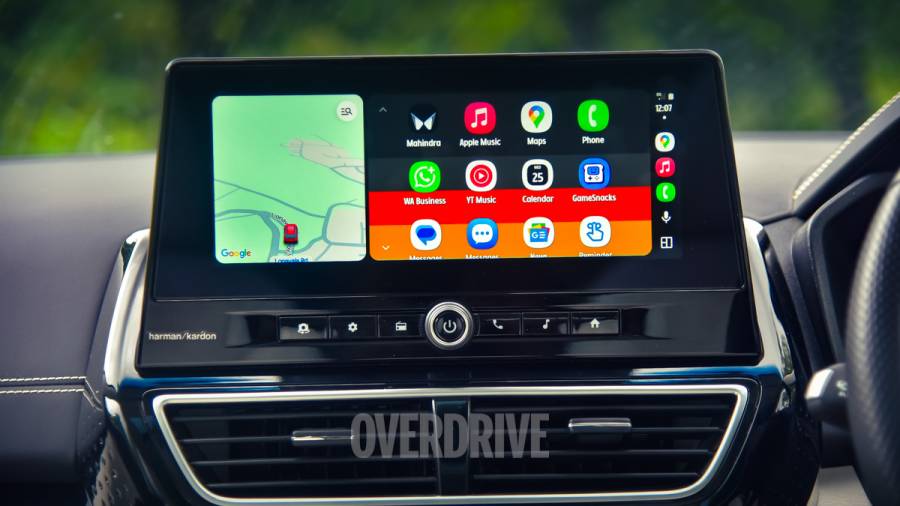
But the 3XO holds its own with its 10.25-inch touchscreen. It's slightly larger than the 10.1-inch unit in the Kylaq but has a more consistent theme to it. It can be a bit clunky with its responses and layout in relation to the Kylaq but Mahindra seems to have worked on this over time. You get a vast degree of connected features which the Kylaq does not quite offer, although both give you in-built navigation.

The Syros gets Kia's latest screen package and is the largest here at 12.3 inches. It's also the most responsive with the richest display and most intuitive layout. The widget-based theme looks modern and it packs in loads of tech, more than the Mahindra. It also gets a small 5-inch climate display that is largely redundant and blocked out of view by the steering wheel.
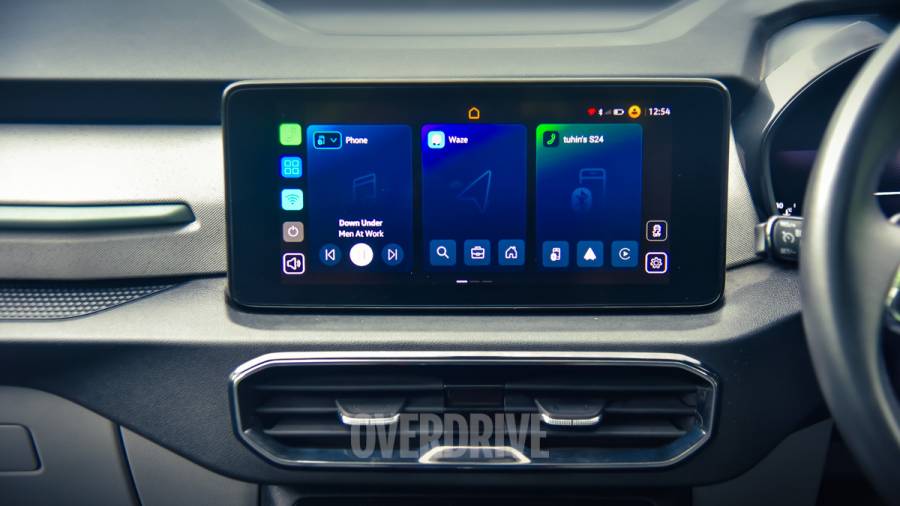
Thankfully, the Kia also now gets wireless Android Auto and Apple CarPlay, bringing it to par with rivals. The Skoda system still works the best, firing up the quickest and most reliably.
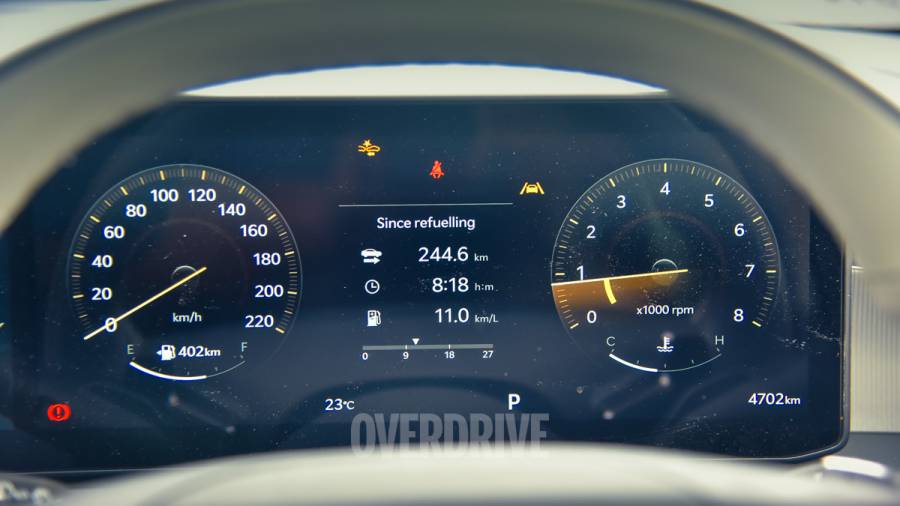
All of these cars also get a driver's display where again the Syros impresses. It's the largest and most legible with logical menus. The Mahindra has a slightly smaller one at 10.25 inches. Its dark themes and small fonts don't quite make it as easy to use and it could have had less complicated menus. The Skoda is a bit behind the others. It only gets an 8-inch display that is quite configurable but not very easily so. There is a lot of blank space around the display that now feels out of place in this segment.
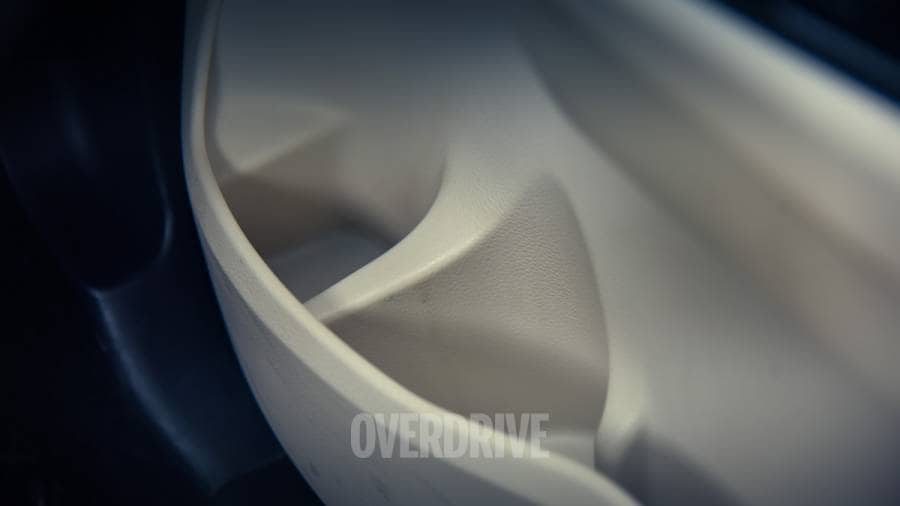
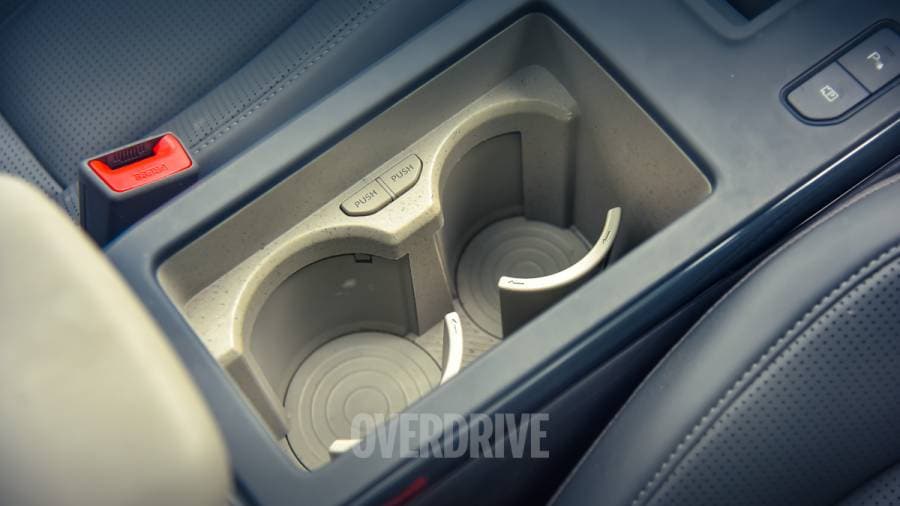
All the three cars here give you wireless charging and numerous charging ports all around. The Skoda and Mahindra have quite large door pockets but the Syros has the most practical centre console. It has deep cubbies, retractable cup holders and a deep central bin. The small tray on the dash also seems the most usable here.
Kia Syros vs Mahindra 3XO vs Skoda Kylaq rear seat comfort
With a wheelbase of 2,600mm and its width, the 3XO is the best car to carry three people in the back seat. Its flat bench is quite typical of Mahindras and may not be the most comfortable over long durations, but it will be the most practical. The white interior trim makes for a general sense of openness, even if it may be difficult to maintain. In terms of knee and headroom, the Syros is close to the 3XO, despite the Kia's smaller 2,550mm wheelbase. The Syros, with its high roof and large windows, gives you a more open feel despite not being as wide.

The Kylaq has a longer wheelbase than the Syros at 2,566mm, but its dark interior and tight packaging makes it feel smaller in the backseat. Three abreast will be the tightest here, although this is the best space if you travel four-up often, with the supportive seat cushioning. The 3XO's seat base could do with a bit more thigh support. It seems as though the floor here is higher than the other two cars. It also has a good recline angle but gets nowhere close to the steep angle the Syros manages.


The Mahindra gets a single Type-C port at the back unlike the two the others have. You do get the 12V socket here though. The Syros is well equipped with ventilation for the seat base, air purifier controls and sun shades.
Kia Syros vs Mahindra 3XO vs Skoda Kylaq Features, Safety
You get most things you might want in a car in these three. Some notable misses are that the Kylaq does not get a full panoramic sunroof or a branded audio system. The 3XO misses out on powered seat adjustment and ventilated seats while the Syros misses auto headlamps. You get dual-zone climate control in the 3XO and an air purifier in the Syros.
The Kylaq has quite a patchy rear view camera, a stark miss when the 3XO and Syros get 360-degree cameras. The ones in the Kia are especially clear. A bigger miss is that of ADAS, which the other two get. The Kia has the widest range of functions, though. Oddly, the 3XO does not get an auto-dimming rear mirror. All three cars here have a five-star safety rating.
Kia Syros vs Mahindra 3XO vs Skoda Kylaq Driving Impressions - engine, performance, NVH
On paper, the Mahindra's biggest advantage on the move is its 1.2-litre motor, while the others get a 1.0-litre. All of these are three-cylinder turbos. The Mahindra is by far the most potent at 130PS and 230Nm (with 91 RON). The Syros (120PS) makes a bit more power than the Skoda (116PS) while the Skoda has a slight torque advantage, making 178Nm against the Kia's 172Nm. The Kylaq and Mahindra get the same Aisin-sourced 6-speed automatic, while the Syros uses the familiar 7-speed dual-clutch.
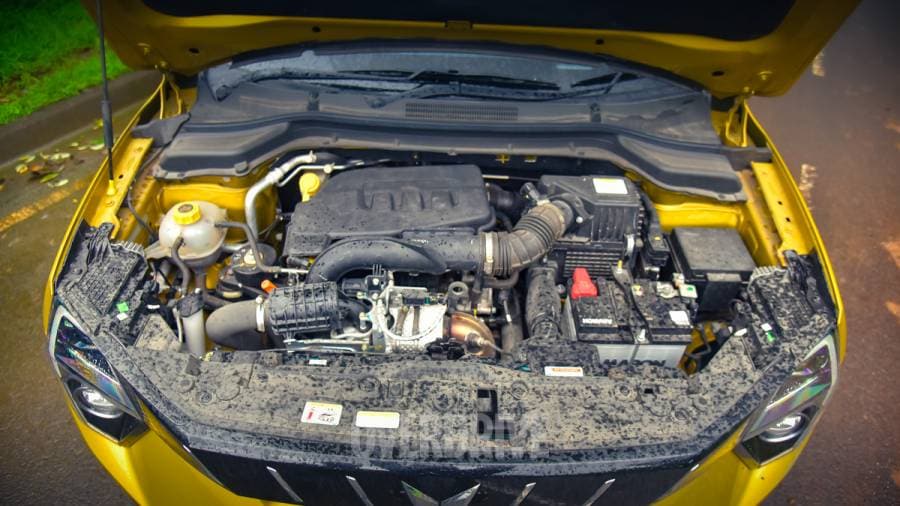
The Mahindra's advantage shows as soon as you set off. It's got a sense of urgency and peppiness that stands out. The Syros has that nice linear pull but it is not quite as potent as this. The Kylaq comes with that strong crawl function that has always been a trait of these MQB-A0-IN cars.

The Mahindra is quite a bit more responsive than the other two. It's a commendable effort given that these Skoda/VW and Hyundai/Kia engines have been quite popular in this segment for a while now. The 3XO has the spirited nature you want to see in a small turbo. When you start unwinding it, there's this big, meaty, mid-range performance which the other two really cannot match.
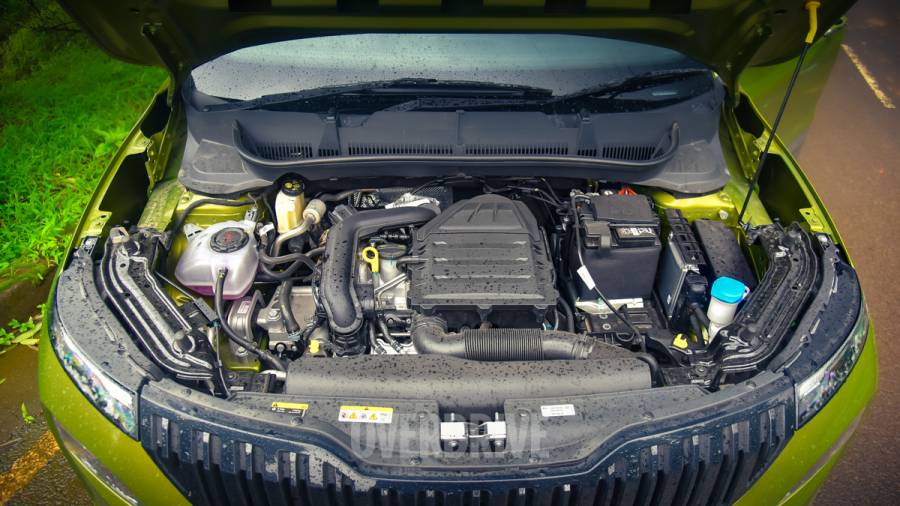
Yes, the Kylaq comes quite close in terms of its tractability. Once it's up and going in the mid-range, it keeps pulling hard longer than the Mahindra. Overtaking is effortless in the Mahindra, while the Skoda makes its case when you need to get up to triple-digit speeds quickly on the highway. You have to work the Kylaq a bit, which can be a good thing sometimes, but both give you that sense of engagement and excitement that you might have wanted in a fast, fun hatchback.
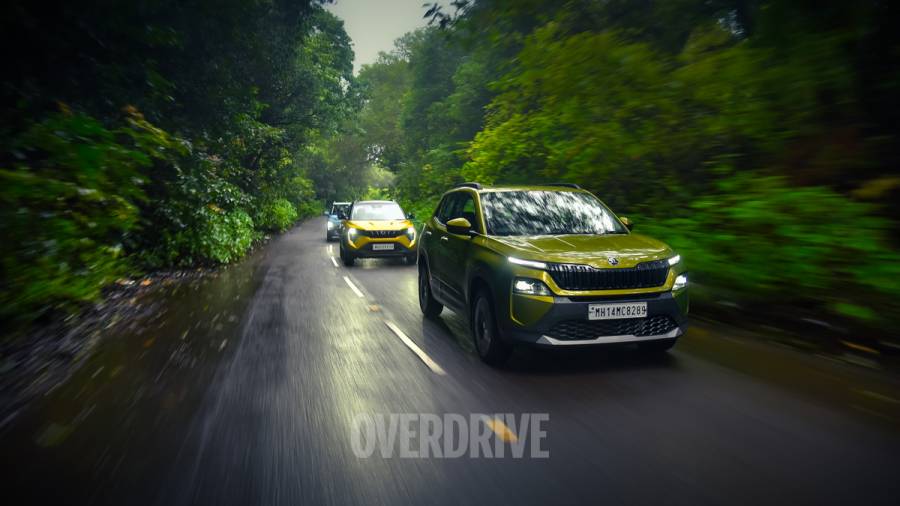
As for the Syros, it's the mellow one of the three cars here. It could do with a bit more go before the turbo spools, but it has a simple, linear power delivery that is practical and easy to get used to. It is meant to be effective and not really exciting, which it does well. You have performance at hand at all times, even if it may be a bit slower than the other two cars here. Even with a DCT, the package seems to have been geared strongly towards convenience and smoothness over performance.
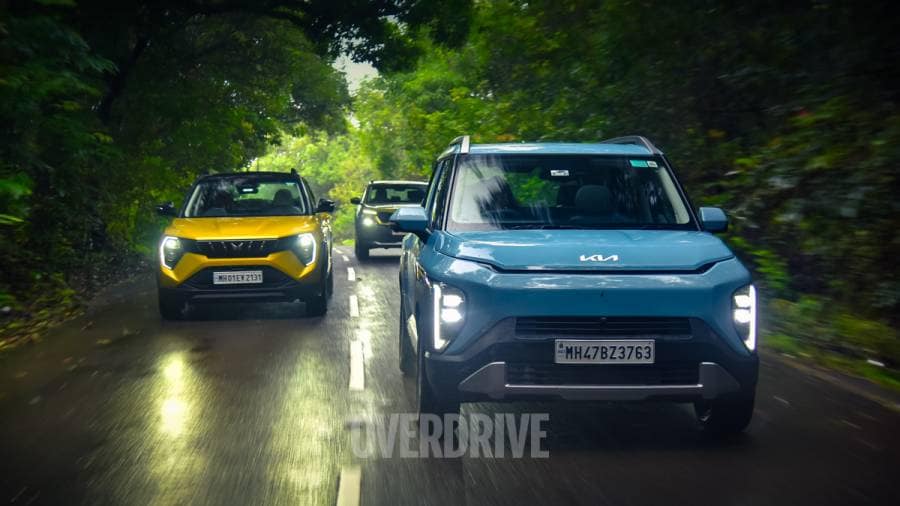
In keeping with this theme, you get drive and traction modes but no Sport mode for the gearbox. The unit also seems to be tuned best for calmer driving. It takes a while to respond to a heavy dollop of throttle but comes through with smooth, clean shifts at part throttle. Surprisingly, the Mahindra does not get a more aggressive gearbox map. This would have exploited the engine's potential further. This shows up more in context with the Kylaq; the Mahindra seems to have the more responsive tune of this Aisin box as default , but, with Skoda adding a Sport mode to the gearbox, there is a lot more being extracted from the engine. The shifts are sharper and quicker too, and quite responsive for a torque-converter via the paddles, another bit of equipment the Mahindra lacks.
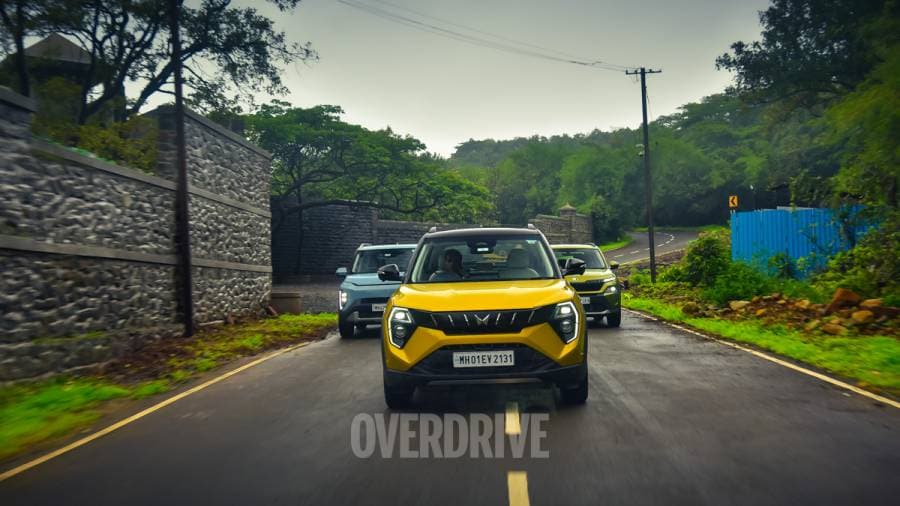
In keeping with its soft demeanour, the Syros feels the most refined. It is especially silent at idle. The Mahindra is good too, and its motor sounds the sweetest of the three here, but you get more wind and road noise than the Syros and it generally does not feel as isolated as the Kia. Skoda has done a lot of work here, but the Kylaq could still do more to improve NVH. It sounds quite gruff and there are still some vibrations that you feel through the wheel.
Kia Syros vs Mahindra 3XO vs Skoda Kylaq Driving Impressions - ride and handling
We said earlier, the Kylaq could be the best driving SUV in this segment, and in this company it seems to prove these chops. The handling is the star here. The steering is light but not as much as the Mahindra and Kia. So, it's convenient in the city, but on a good driving road, the Skoda gives you the most confidence of the three. It's predictable in how it leans, enough for you to have a good idea of what the nose is doing. The compact dimensions seem to come in handy. This sensation is also helped by the fact that you do not sit very high up.

It must be said that Mahindra has done quite a good job in coming reasonably close to the Kylaq. You still can get a smooth flow going in the 3XO, especially with that very potent engine, but you realize that when the car is loaded up into a corner, maybe it's not quite as sure-footed and as fluid in its motions as the Kylaq. The steering could be a bit more communicative in these situations. The steering modes add heft but do not improve directness.
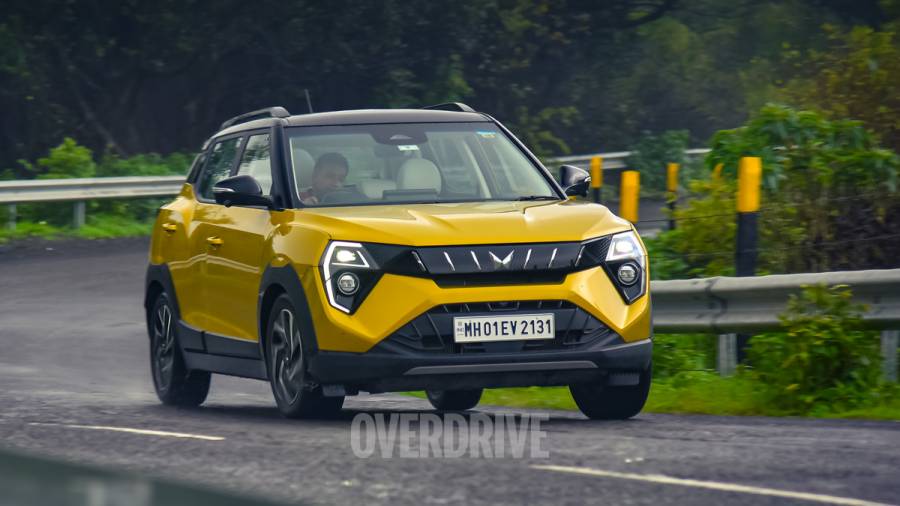
The Syros was never really meant to appeal to the enthusiast and it shows in the way it drives. You notice that it has quite a bit of body roll relative to the others with that high roof design. As long as you keep speeds in check, it's fine and you will make smooth progress. But the Syros does not like going around corners at similar speeds as the Kylaq and 3XO. It seems to want to not turn as easily as the others. The roll is also quite sharp, which despite its comfort focus, could have been more smoothly executed. It has the best braking performance of the three, which the Kylaq also manages with rear drum brakes commendably. The Syros is quite good in a straight line, the Kylaq is still the most stable, but the Syros is secure too. The 3XO could be better here. You feel like you are moving around a bit more than the others.

Now you might be thinking that the Syros, with its family-focused approach, might be the most comfortable car here when the road gets rough, but that's not really the case. It's the Mahindra that seems to isolate you best. These top-spec versions run 17-inch wheels so there is a degree of firmness involved with all three, but the Mahindra seems to tune this out the best. The Kylaq, given its handling focus, finds a good balance. It's firm but this does not jar you in the cabin, you still stay quite composed. The Syros can't quite isolate as well. It's less about how firm it is. There seems to be a constant pitching and bobbing sensation on patchy city roads that gets uncomfortable over time.
Kia Syros vs Mahindra 3XO vs Skoda Kylaq Real-world fuel efficiency
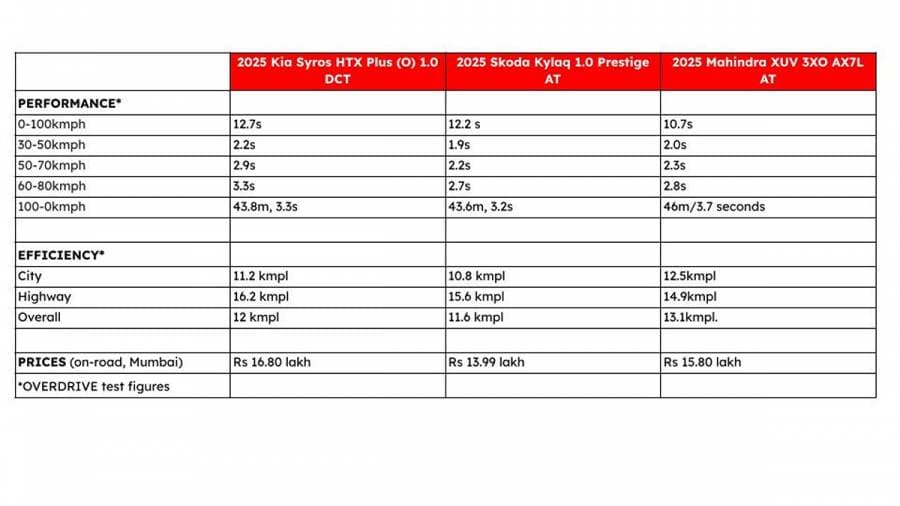
The Kylaq and Syros are similarly efficient, returning around 12kmpl. The Kia is better with its drive modes and the extra cog. The 3XO is surprisingly the most efficient, largely due to it remaining quite subdued in its Eco mode. The Syros is the most efficient on the highway at 16.2kmpl, the 3XO does the best of the lot in the city with 12.5kmpl.

Kia Syros vs Mahindra 3XO vs Skoda Kylaq Driving Impressions Price, Verdict
At Rs 16.80 lakh(all price on-road Mumbai before GSt cuts), the Kia Syros is pricey. You get a ton of equipment for it but this is C-segment money and the Syros does not quite have the driving ability to justify that. It is still, by far, the most premium space here and should be the car for you if you will spend a lot of time in the back seat. The Kylaq handily undercuts the other two cars here at Rs 13.99 lakh. It may lack the space and creature comforts of the others, but the smart driving dynamics and proportionate styling help it stand out. The Mahindra 3XO is still pricey at Rs 15.80 lakh, but seems to be the best all-round package. It has that potent motor, a good features and safety package and feels good enough on the road to satisfy all buyers.
Kia Syros vs Mahindra 3XO vs Skoda Kylaq Scorecard

Starts Rs 7.95 Lakhs
1197cc
Manual
110.1
200
-NA-
Starts Rs 10.5 Lakhs
999cc
Automatic
149
178
15.78 Kmpl
Related Stories